I was pleased to see that my post on user experience design in journalism education attracted the attention of a blogger who is pursuing graduate studies in Interactive Media with a focus in precisely this area. (Can’t find the blogger’s name, I’m afraid, but the blog is called UX+JX, which is catchy and cute in a geeky way.) I’ll be looking forward to the progress of this new colleague’s dissertation research. I’m also grateful for the pointer to Cindy Royal’s fascinating 2010 ethnography (.pdf) of the New York Times Interactive desk. Perusing her site, I also came across this May, 2009 Online Journalism Review article on News as User Experience, which serves as a decent general introduction to the concept for news organizations.
When two or three are gathered in the name of journalism and user experience design….
The Forethought: Du Bois the Journalist
Table of contents for Not the Subject, But the Premise: Postcards From the Edge of DuBois' Black Belt
Author’s note: This part of an unpublished 2002 essay, “Not the Subject but the Premise: Postcards from the Edge of Du Bois’ Black Belt,” is reproduced here for comment and as fodder in the body of work upon which I am drawing for my sabbatical project. I consider it to be a failed work with some useful nuggets.
“‘[T]he sheriff came and took my mule and corn and furniture –
‘Furniture?’ I asked; ‘but furniture is exempt from seizure by law.
‘Well, he took it just the same,’ said the hard-faced man.’”
– WEB Du Bois in Dougherty County, Georgia
“Of the Black Belt,” Souls of Black Folk, 1903.’
“It’s alright now/
alright now/
I gave it over to Jesus/
And it’s alright now.”
– sung at St. Mary’s Holiness Church in Hamlet, North Carolina, May, 2002
The Forethought: Du Bois the Journalist
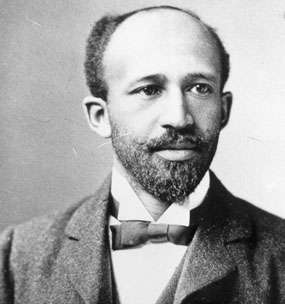
Before he became a scholar, activist and would-be Bismarck of his race, William Edward Burghardt Du Bois (1868-1963) was a journalist. As a teenager in Great Barrington, Massachusetts, young Willie was a correspondent for the New York Globe, Freeman and Springfield Republican; at Fisk; he edited the school newspaper. After two commercially unsuccessful attempts to create his own journal of news and opinion, his Crisis magazine would be integral to the birthing of the modern civil rights coalition as well as the Harlem artistic movement of the 1920s. After both of his departures from the NAACP, in 1934
and 1948, he became a regular contributor to several black and later, radical news organs.
The Souls of Black Folk is suffused with the best journalistic sensibilities: vivid description, pithy characterization, abundant but carefully chosen detail, and evocative narration. This, along with its seminal influence on racial thought, explains why the faculty of New York University gave Souls and his Crisis columns on race two separate spots on its list of the 100 best works of journalism of the 20th century. (NYU) Despite this, and the growing scholarly attention to Du Bois’ writings, the consideration of his work as journalism has been slight. Most of the attention that has been accorded has gone, understandably, to study of The Crisis.
Du Bois’ reporting was part of an evidentiary brief that, if heeded, would lead to greater support for the policies he advocated for black advancement: fair wages, rents and opportunities for land ownership investment in higher education, and physical safety. In using journalism as one of his weapons, he seems to have understood what media scholar Michael Schudson meant when he declared of 20th century reporting,
“…[T]he power of the media lies not only (and not even primarily) in its power to declare things to be true, but in its power to provide the forms in which the declarations appear. News in a newspaper … has a relationship with the ‘real world,’ not only in content, but in form; that is, in the way the world is incorporated into unquestioned and unnoticed conventions of narration, and then transfigured, no longer a subject for discussion but a premise of any conversation at all.” (Lule)
This essay will consider two journalistic essays in Souls of Black Folk. Particular attention will be given to what Du Bois saw as the proper aim of journalism, and the proper role of the black journalist. The power of Du Bois’ journalism in Souls lies in the specificity with which he placed black life in the context of the social and historical forces that shaped its essential character and defined its structures of opportunity. We get a glimpse of his nascent ability to draw out the multiplicative ways in which African Americans adapted to and agitated against their oppression. However, when viewed in terms of the evolution of racial discourse however, it may be that the most profound effect of Du Bois’ journalism was his ability to demonstrate the centrality of black labor, black culture and black action to American prosperity, identity and well-being. Ironically, we shall see that it is this example that contemporary African American journalists find themselves most challenged to follow.
In Souls, Du Bois the reporter is most evident in Chapters Seven and Eight, “Of the Black Belt” and “Of the Quest of the Golden Fleece.” Both chapters are portraits of Dougherty County, Georgia. As works of journalism, they presage what Tom Wolfe preciously called the New Journalism of the 1960s — the blending of observation, contextual data and narrative technique. There is, however, another way in which the work has contemporary resonance: as a black journalist whose audience and markets crossed racial lines, Du Bois had to grapple with an oppressive and intricate racial ideology that constrained and
discounted not only about such southern blacks as were found in Dougherty County, but also educated northern blacks as himself.
Du Bois had to convince his readers that he was an authoritative interpreter of African American experience – a task made more difficult by the fact that his objective was to supplant what his readers thought they know about his subject. His task was complicated by several unique factors. One the one hand, he had to contend with those who would argue that Du Bois’ mixed racial background made him incapable of understanding the souls of real black folk. On the other, Du Bois faced the personal challenge of understanding people whose skin tones resembled his or his family members, but whose lives under Reconstruction and Jim Crow differed radically from his comparatively Edenic boyhood in Great Barrington, Massachusetts. Finally, he had to contend with emerging standards both of scholarship and of journalism that discounted traditional rhetorical strategies employed by earlier black writers, such as appeals to emotion, biblical authority and first-person narratives.
If he faced unique challenges, Du Bois was also unique in the resources that he brought to the task of destroying and rebuilding the foundations of racial discourse. He could rely not only on his youthful reporting experience, expansive knowledge base and considerable literary gifts, but also the data collection that he was beginning to amass through his work for the U.S. Bureau of Labor Statistics and his direction of the Atlanta University studies. (Lewis, Biography, p. 195) Du Bois was a pioneer in the emerging field of empirical sociology, and the AU studies were part of his lifelong effort to build a comprehensive data portrait of every imaginable aspect of black life — from schooling to economic development to religion and family life. He had invented many of the fields’ methods of data collection and analysis during his first major sociological project, The Philadelphia Negro – among other things, he personally interviewed 3000 black residents of Philadelphia’s seventh ward.
According to Lewis, his principal biographer, Du Bois bragged that his knowledge came from having “lived with the colored people, joined their social life, and visited their homes.” He was particularly scornful of the “car-window sociologist,,, the man who seeks to understand and know the South by devoting a few leisure hours of a holiday trip to unraveling the snarl of centuries….” (Souls, p. 128) In other words, he practiced immersive reporting long before there was a name for it.
Above all, Du Bois struggled to hold to his sense of personal and racial mission. As one of a small number of African Americans who had access to an elite education, Du Bois believed fervently that the future of the race depended on the disciplined, clear-eyed leadership of liberally educated men and women. He had declared, early on, his intention to be one of those leaders. On his 25th birthday, alone in his graduate student quarters at the University of Berlin, Du Bois wrote in his journal, “These are my plans: To make a name in science, to make a name in literature, and thus to raise my race.” (Lewis, Biography, p. 135)
Du Bois was not alone in his efforts to expose the fetid underside of American industrial development. This was, after all, the era of combat between the muckraking journalists and the robber barons. Ida Wells had published her anti-lynching expose, The Red Record. Lincoln Steffens was exposing The Shame of the Cities. Ida Tarbell was publishing her voluminous analysis of Standard Oil.
In fact, Tarbell’s disclosures specifically motivated the Rockefellers to disburse millions to establish the General Education Board (GEB) and the Southern Education Board (SEB) — two foundations that, in the absence of federal involvement in public education, would dominate African American education policy at all levels for decades to come. (Lewis 265-268) Emphasizing ”scientific philanthropy,” the GEB directed most of its funding to industrial and moral education programs at schools such as Booker T. Washington’s Tuskegee Institute. The GEB was composed of some of the most powerful men in America, so their positions on black education limned the boundaries of mainstream thinking on race.
Scholastic Journalism Education as a Tool for Teaching Computational Thinking
Table of contents for Computational thinking in journalism
- As we change journalism education, we need to study journalism learners
- A foundational concept for the new news economy
- What Would WEB Du Bois Tell Henry Jenkins and Soulja Boy?
- Building the bridge between journalism and computer science
- Can VIBE magazine be saved? And should we care?
- Scratch as a Tool for Teaching Computational Journalism
- Crafting Literary Journalism
- How stories and network science could improve educational equity and diversity
- What computing and informatics tools will help Haiti?
- Why I fear I’ll never master SEO
- You’re gonna need to read this, but it won’t be on Amazon
- Scholastic Journalism Education as a Tool for Teaching Computational Thinking
- How should journalism educators teach and study social media?
- What is a computational journalist?
- The Food Stamp Game: a test case for teaching computational journalism, part 1
- On teaching game design in a journalism course, part 2
- On teaching game design in a journalism class, part 3
- On teaching game design in a journalism class, Part 4: Newsgames as literary journalism
Greg Linch’s April 30, 2010 post at the Publish2 blog improves upon my May 2009 post on computational thinking in journalism by placing it in the context of the larger conversation about the skills and habits of mind that journalists now need. He also offers helpful suggestions about specific computer science concepts that journalists ought to understand. Linch lists abstraction, debugging, defining variables, and commenting code as examples of computer science concepts that parallel traditional journalism skills and functions.
Should Mamas Let Their Babies Grow Up to Be Journalism Majors?
Journalism education as a tool for culturally responsive teaching
These slides are from a presentation I gave in January 2008 at the Culturally Responsive Teaching, Leadership and Counseling Symposium at the University of Colorado-Colorado Springs.
What should journalists know of philosophy?
Table of contents for Philosophy of Journalism
- What should journalists know of philosophy?
- An Ontology of Journalism
Carlin Romano, critic at large for the Chronicle of Higher Education and former reporter for the Philadelphia Inquirer, has taken heat for his recent essay arguing that more philosophers ought to be taking up journalism as a focus of inquiry, and more aspiring journalists ought to be taking a class like the one he has taught at various colleges and university over the last 25 years. He summarizes that course thusly:
“So I constructed a basic course that examines journalism in the light of philosophical thinking in epistemology, political theory, ethics, and aesthetics, mixing philosophical and journalistic materials and vocabularies. In Part 1, we scrutinize “truth,” “objectivity,” and “fact.” In Part 2, we explore how journalism might fit classic modern theories of the state, including that tradition from Locke to Rawls that largely ignores the “Fourth Estate.” In Part 3, we ponder how what practitioners call “journalistic ethics” fits with broader moral theories such as utilitarianism. In Part 4, we investigate whether journalism can be art or science without overstepping its conceptual bounds. The guiding principle was a variant of Browning: One’s reach should exceed one’s grasp, or what’s a syllabus for?”
lf philosophy blogs are any indication, Romano’s word was not kindly met. University of Chicago law professor Brian Leiter thinks that the column’s real message was, “Why is Brian Leiter so mean to me?” Apparently, they’ve had some sort of running feud. In any event, he dismisses Romano’s thesis:
“As to why ‘philosophy of journalism’ is not a major topic of philosophical study, I would have thought the answer obvious: it’s not a central or substantial intellectual or cultural practice, unlike science, art, or law. The idea that “philosophy of journalism” would displace the central subjects of the discipline for millenia–metaphysics, epistemology, value theory (the ones too “abtruse” for Mr. Romano to understand)–is sufficiently silly that only a journalist could propose it.”
More constructively, Ben Hale, a philosophy professor at the University of Colorado at Boulder, picked up Leiter’s post and suggested that philosophers might contribute the the discussion of journalism ethics. One of his commenters took specific exception to Leiter’s marginalization of journalism as a cultural practice:
Is he suggesting that journalism really is NOT one of the main conduits by which modern society learns about its current affairs? Is he really suggesting that journalism is NOT a way that culture is constructed? Does he really believe that the vast majority of people in the world do NOT learn about everything from the failure of their local schools to educate their children to the failure of central governments to take adequate steps to prevent a new financial bubble? (Not to mention such essential pieces of information as precisely which drug killed Jacko, and just how mind-blowing Britney’s new CD is, as I learned on NPR the other day. No kidding.)
Hans Holbling at the Galilean Library allowed that Romano’s goal – helping journalists’ become more “philosophically astute” — might be a worthy one, but he raises interesting questions about the how the field of philosophy would be advanced by a focus on journalism and media:
“If we have journalists who are able to question their own preconceptions, avoid inductive inferences from small data sets, and so on, then let’s suppose this is a good thing for both journalism and for those consuming the products of journalism. Why do we also need philosophers to understand the intersubjective standards setting these journalists report on? Unless we presuppose that only philosophers can teach the journalists to be more philosophically astute, or even if we don’t, it seems the development of philosophers can be left out of this. A more accurate requirement might be: we should get journalists to study the philosophical aspects of their work to help develop a more valuable form of journalism.”
like Holblin’s reformulation very much, and I see some value in Romano’s course. Indeed, much of my own journalism teaching is an attempt to engage students in philosophical reflection on the ethics, esthetics, epistemology, and rhetoric of journalism as it is practiced currently and historically in the United States. However, I am not a trained philosopher, and I work hard every semester to make up for that gap. So far, I’ve been able to do this without making my colleagues in our philosophy department retch, because my best and most demanding teacher, my father, started me reading Plato from the time I was about nine, and we’ve gone on from there.
Infusing philosophical literacy into journalism education
All of that said, I don’t think Romano’s required “Philosophy of Journalism” course is an adequate solution. Journalism education is being rethought, and should be, prompted largely by the fundamental shifts in economics and technology of newsgathering and delivery. I think Romano is particularly off-base when he argues that foundations and university journalism departments should require the formal study of the philosophy in order to “[focus] on long-standing gaps in journalism education” instead of the “bells and whistles of new technology, as if tweets will save us all.” This, I submit, is a false choice.
Instead, I would argue that we need to infuse philosophical thinking into every aspect of media study and practice. It’s a particularly good thing to do now because so many fundamental aspects of the field are changing. I don’t pretend to be an authority on how to do it, but it has to be done. I wish there was more of a conversation between journalists and philosophers — and here is where I agree with Romano — because I suspect both fields could benefit. If, as I’ve read, philosophers do use news stories as a starting point for many of their own inquiries, why would it not be useful to understand how journalists and journalism scholars approach these issues?
So I thought it would be useful to run through a list of essential philosophical concepts and texts that journalists should understand: I will freely admit that in attempting this, I am exposing my own clumsiness with the subject, but that is the only way that I know of te learn. I welcome additions, including suggestions about the courses in which these concepts and texts might best fit. I will do that in one of the the posts that follows.