Teaching Games as Journalism: Pedagogy and Practice

Presentation to the NSF C-PATH Distributed Expertise Colloquium, Villanova University, June 3, 2013

A guide the acronyms and some other helpful references:
JPW- journalism/professional writing major at The College of New Jersey
IMM – interactive multimedia program at TCNJ
DE – C-PATH Distributed Expertise project NSF Award Abstract
Wolz’ Simple Storyteller
On teaching game design in a journalism course, part 2

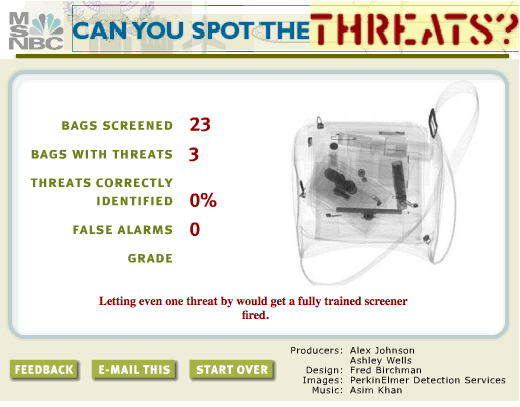
In my last post on the newsgames course I will be teaching this fall, I began to discuss how the need to respect the journalistic intent of a newsgame translates into requirements and constraints upon the game’s design and production. In this post, I want to  delve into that topic more deeply, using principles outlined in Tracy Fullerton’s Game Design Workshop: A Playcentric Approach to Designing Innovative Games, and applying those principles to a game that I consider particularly successful, MSNBC’s “Can You Spot the Threats?”  game about the challenges of screening airport baggage.  Finally, I will discuss questions that I will raise with my students about my partially finished “Food Stamps Game,” which I introduced in the last post. The intent of the Food Stamps Game is to simulate the experience of trying to buy a week’s worth of groceries on a $30 budget, about average in terms of what states allow a single adult participating in the Supplemental Nutrition Assistance Program (SNAP) which is the current name for Food Stamps. (Eligibility for benefits and benefit levels vary, and are based on complex criteria. See references on benefits at the end of this post.)

Fullerton defines a game as:

  • A closed formal system that
  • Engages players in structured conflict and
  • Resolves its uncertainty in unequal outcomse (p, 43)

MSNBC's game about airport baggage screening successfully incorporates dramatic and formal elements.

Here, an aside: It should be noted that Fullerton’s definition of a game is at slight variance with that employed by the authors of the other text that I plan to use in the course, Newsgames: Journalism at Play, which I discussed in the previous post. The Newgames text considers animated infographics as games, where as Fullerton is more restrictive. I bring this up because this is an interdisciplinary class in which some of the students are already familiar with Fullerton;s formulations. I may need to take these differing perspectives into account in order to build a common intellectual climate within the class.

Part of the value of Fullerton’s definition is that she breaks it down into components that can be understood as operational requirements.  Games have what Fullerton describes as formal elements (such as rules, playing pieces, boundaries and outcomes), dramatic elements (premise, setting, character and a dramatic arc), and system dynamics (the way the formal and dramatic elements interact). Please note that Fullerton’s definition of these categories is more extensive than I have presented here. This list is only  for the sake of illustration and discussion.

Applying Fullerton’s rubric to MSNBC’s “Can You Spot the Threats” game helps us to understand more about her categories, as well as the characteristics of a successful simulation-type game. The game starts with ominous music and a voiceover narration about the ways in which airport baggage screening procedures changed in the United States after the terrorist attacks of 9/11. Then you are told that you are about to experience what it’s like to screen baggage for two minutes. A series of actual images of luggage generated by screening equipment scrolls across the screen, and you have to pick out the bags most likely to contain guns, knives or explosives. However, the pictures are frustratingly blurry and vague, as can be seen above. You can stop an image, zoom in, and change the black-and-white image to color, but the images are still non-descript. Take too long, and the passenger murmuring in the background rises to a fever pitch. Move too quickly, and it’s likely that something dangerous will slip through. At the end of two minutes, you get a score based on the number of bags screened, the number of dangerous bags detected, the number missed, and a score.

In Fullerton’s parlance, there are formal elements – rules, resources (the bags, the controls), boundaries (the time limit, for example) and outcomes. There is a real-world premise, a story in with characters (you, the baggage screener, and the passengers),  a setting, and a simple dramatic arc. The flash program functions efficiently, and the interface is clean.

“Can You Spot the Threats?” is one of the most effective newsgames I’ve seen, both When I had a class of about 24 students play this game in 2003, they said they gained a new appreciation for the difficulty of the baggage-screener’s job, and motivated them to read the accompanying web feature article. My campus is an hour’s train ride from Ground Zero, and the 9/11 attacks were still evoked a visceral emotional response from my students. They said they found it easy to accept the game’s premise, and they felt anxious as the blurry images rolled across the screen and passengers began to complain that they might miss their planes.

These are some of the ways in which the Food Stamps game is unfinished and needs revision.  As some test users report, the boundaries of the game aren’t always clear – for example, a script that should come up when a buyer runs out of money doesn’t yet work properly. There aren’t enough dramatic elements and the system dynamics could use some work. These will be some of the things that will be fodder for discussion with students in the fall.

Arguably, the flaws in this game, and the ability to download and remix the code in Scratch, makes the Food Stamps game useful as a tool for highlighting this game and its design process as an example of computational thinking. I will elaborate on that in the next post.


Endnotes

References on benefits. For more information on how states calculate Food Stamp benefits, please see examples below:

  1. USDA SNAP Eligibility page
  2. Texas: Food Stamp Benefit Estimator
  3. Illinois: DHS Supplemental Nutrition Assistance Program
  4. MassLegal Services. 2011 Food Stamp Advocacy Guide Part III. Eligibility
  5. Hawaii Financial  and SNAP Benefits RIghts and Responsibilities
  6. Louisiana Department of Children and Family Services: Economic Stability Supplemental Nutrition Assistance Program
  7. South Carolina Department of Social Services SNAP Benefit Calculator
  8. 2007 Congressional Food Stamp Challenge
  9. US Food Policy “Living on a Food Stamp Budget” (This is the specific source of my $30/week figure.

Course syllabus as of July 13, 2001


    The Food Stamp Game: a test case for teaching computational journalism, part 1


    This fall, I am teaching a class, “Serious Games for News, ” in which journalism and interactive multimedia students will analyze and design various examples of “newsgames.”  In their book,  Newsgames: Journalism at Play(MIT Press, 2010) Ian Bogost and his colleagues use the term Newsgames to mean, broadly, using game design techniques to “do” journalism – that is to report, present and or comment on the news. That broad definition takes in everything from crossword puzzles to videogame-like simulations and alternate reality games of the type created by futurist Jane McGonigal. Since the students in the class are journalism and interactive multimedia majors, not computer science students, I see the class as a practical exploration of computer science concepts relevant to journalism, as well as an opportunity to learn about and test the possibilities of this rapidly developing journalistic medium.

    Newsgames: Journalism at Play

    The journalistic focus of the class will be on two pressing issues in Trenton New Jersey, the city just blocks away from the location of our college -pollution and food security. Trenton has experienced the difficulties that have beset many industrial American cities: disinvestment, environmental degradation, and a crumbling infrastructure. Enrollments in the federal supplemental nutrition assistance program have risen precipitously in the last five years. How can newsgames make the issues more visible, more comprehensible, and more amenable to citizen dialogue, engagement and resolution?

    As part of my preparation for the class, I thought I would create a sample newsgame  in Scratch for the students to critique and remix. The the game below challenges players to buy a week’s worth of groceries on a food stamp budget – about $30/week, according to my research.  (The title reflects my age – when I was growing up, people getting government assistance to buy food got a coupon book from what was called the Food Stamp program. Now, they get an ATM-like card called an “EBT card,” and the program is now called the Supplemental Nutrition Assistance Program.)

    The version below is in the user testing phase and will probably undergo some refinements in the fall, but I do not intend to present it to students as a finished product. In addition to some technical glitches, I think it has some important design flaws. I don’t think it has enough story elements to make recreate the experience of having to shop with an EBT card. (what . I have some ideas on how to make it more realistic – swap out the images for images from Trenton, add voices and back stories of real people, add more items to better illustrate the trade-offs people have to make..

    Part of the conversation that I want to have with the students is to raise the question of how much information needs to be built into the game, and how much would need to be part of another story package. Maybe this is the wrong focus for a game about food insecurity in Trenton  - perhaps the focus should be on applying for benefits, or running one of our over-stretched food pantries. Perhaps it can be part of a suite of games around this theme.

    The idea is to get the students to first try to improve on what I’ve done, and use the strength and weaknesses of my approach, along with the guidance from the texts, to develop their own ideas.

    In this series of posts, I want to share some thoughts about what I expect my students to learn from working with this game and creating others like it.

    A Note on the Use of Scratch

    I chose to use the Scratch programming language for this class for the following reasons:

    • It has a low learning curve, but contains many of the features of more sophisticated  languages
    • It allows programmers to import their own still images and audio, which means that we ought to be able to achieve a strong documentary effect on the games we produce.
    • The Scratch website makes it easy to organize student work into galleries, and the uploading feature of the software has built-in version control, so it’s easy to see how projects evolve.
    • Interactive games and stories can be prototyped in Scratch relatively quickly for larger scale production in a subsequent course. We have done this successfully for several years at The College of New Jersey.


    In reflecting upon the game design process in the context of journalism pedagogy, and on the use I expect to make of this game in particular, a series of guiding questions and considerations emerge that I want to share here.

    Learn more about this project

    Game design as journalism: general questions and considerations

    • What’s the journalistic goal of making this or any other newsgame?As with text, video, audio, still images and static information graphics, the value of news games as journalism is a function of editorial judgment and skill. Regardless of the medium, the focus is on the story one is trying to tell.

    My goal with the food stamp game is to find new ways to share information and provoke conversations about poverty and the problem of healthy food access in poor communities. The actual experience of shopping with an electronic benefits card (EBT card for short) is something that many Americans, and thousands of Trenton-area residents experienced for the first time during the economic downturn of the last few years. They have joined an often-invisible army of millions. In 2008, the Columbia Journalism Review considered the need for fresh ways of shining a spotlight on the problems of the poor:

    “How can a reporter cover that most persistent of problems, poverty, today without making it boring and predictable, or guilt-tripping readers and turning them off?”

    Hypothetically, simulations of how poor people attempt to meet basic needs might be a way of engaging news consumers and encouraging further exploration of the issues raised. To test this hypothesis, I plan to have students consider how the Food Stamp game might be improved both as a work of journalism and as a computing artifact. As the course evolves, I expect that other approaches to these and similar projects to emerge.

    • What kinds of stories and issues lend themselves best to newsgames and especially, to which type of game? Should the game stand alone or should it be combined with other forms of storytelling and exposition?

    Using Wired.com’s “Cutthroat Capitalism” interactive feature and simulation game about the business model behind Somali piracy as an example, the Bogost text notes that game design techniques open up ways of revealing complex systems. Both the feature and the game make the point that piracy continues off the coast of Somalia because the shipping companies targeted find it more profitable to risk being pirated and pay ransoms than to change their shipping routes. For their parts, the pirates also find the potential wealth to be garnered from crime to be more lucrative than the alternatives available to them, despite the risk of arrest or violence.

    The feature uses the expository technique of process analysis, a method for explaining the how or why something happens or is done. This is a common technique in magazine writing, especially for articles designed to impart personal advice, or to explain how a big news event happened. tt frequently lends itself to a very structured layout with accompanying graphics. (This Jan. 1992 Black Enterprise package, “The Big Comeback” which I worked on with Dawn Baskerville, is typical – it offers advice on how to recover after falling into debt.)

    The Wired.com narrative feature, though, tries to do something more ambitious, which is to make an economic analysis interesting and accessible.

    Wired’s Cutthroat Capitalism feature story and game broke new ground

    It is organized into four sections:

    1. The Hot Zone:Pirates Know Plunder Pays
    2. The Attack: Shippers Brave Shortcuts Through Pirate Waters
    3. The Negotiation: Offer or Counteroffer, Shoot or Stand Down?
    4. The Resolution: Sealing the Deal and the Getaway

    From the perspectives of computer science and game design, Wired.com structured and highly visual approach to the narrative was highly conducive to the kind of abstraction needed to create a game to complement the feature.

    The process analysis method contrasts with the human-interest angle, another popular feature writing technique for approaching complex issues. Human interest stories help us understand what it feels like to be caught in the middle of a complex event, as Alfred Lubrano of the Philadelphia Inquirer does beautifully in his 2010 series on hunger in Philadelphia’s first congressional district.  Lubrano shows us hardworking parents rendered incapable of feeding their kids by sudden job losses, and spotlights a dedicated social worker struggling to help them. The series had an impact, too – readers responded by helping one mother find a new job and an apartment.

    In theory, a well-designed game could complement a strong human-interest series. The food stamp game is one example of such a complementary

    A Portrait of Hunger - by Alfred Lubrano

    Alfred Lubrano’s Philadelphia Inquirer series on hunger inspired readers to help one struggling mother find a new job and home for her family.

    effort. Other examples might be designed around the challenges faced by a social worker struggling with a burgeoning caseload,  or a social entrepreneur looking for ways to bring jobs and a healthy environment back to the community.

    • How do the journalism goals of the game translate into design requirements – and constraints- for the game?

    Creating a game from a complex narrative, whether real or imagined, requires a level of abstraction that can have all kinds of unintended results. The interactive story Façade has been hailed for the sophistication of the artificial intelligence that allows the gamer to participate in a drama whose narrative arc bears an impressive similarity to the Edward Albee masterpiece, Whose Afraid of Virginia Woolf. In 2007 and 2008, I asked a number of students and others to play Façade and observed the results. After watching about 40 people between the ages of 15 and 45 participate in the story, I saw a consistent tendency to “game” the story. Instead of becoming immersed in the drama, players did things that they thought would skew the game one way or another, often with results they found hilarious. I think that this was partially a function of the rudimentary quality of the 3-D graphics (a compromised necessitated by the processing requirements of the AI.)  It became obvious that the experience of Façade is nothing like that of the drama that inspired it. This may be fine in this instance because the two works stand apart from each other, but a similar result in a game with a journalistic purpose threatens to trivialize the story or issue that it is trying to elucidate.


    Clearly, then, the journalistic success of The Food Stamp Game project requires careful attention to the dramatic elements – or the storytelling experience of the game, along with the formal game elements (such as rules) or the technical requirements. For a further understanding of these challenges, I will have students turn to the guidance in Tracy Fullerton’s Game Design Workshop: A Playcentric Approach to Creating Innovative Games along with some of the project management techniques that my colleagues and I have developed in seven years of teaching game design at The College of New Jersey. I will discuss this in a subsequent post.

    Acknowledgements: This work draws upon research funded by Microsoft Research and National Science Foundation grants 0739173 and 0829616

    Interdisciplinary Computing Blog: Interdisciplinary Computing Meeting Number 2: Day 1, Part 1

    Liza Kaczmarscyk does a nice job of capturing the first day of discussion at our meeting on Creating a Climate for Interdisciplinary Computing. The discussion on computational journalism to which she alludes was initiated by yours truly and Rich Gordon from the Medill School at Northwestern University. Other journalists here include Jonathan Tracy from the AP, Michelle Ferrier from Elon University, and Barbara Iverson from Columbia College, Chicago.

    Sidebar: Learning about learning – a conversation with Deborah Tatar

    Dr. Deborah Tatar, Virginia Tech

    Deborah Tatar, cognitive scientist at Virginia Tech

    Deborah Tatar is a cognitive scientist at Virginia Polytechnic University whose current research focuses on understanding and clearing the obstacles to student learning in mathematics and science. For example, she was a principal investigator on the SimCalc project, a software-based interactive math curriculum for middle schoolers that has shown demonstrable success when accompanied by professional development for teachers. She is a collaborator on the CPATH Distributed Expertise project for which I am a co-PI.

    In this conversation about what it takes to bring students from under-represented groups into computing, Tatar cautions against easy generalizations and simplistic solutions, offering intriguing possibilities for ways in which we can assist learners in finding the paths to understanding that are most appropriate for them.

    Tatar’s insights remind me of Georgetown University math professor Jim Sandefur’s use of “think-alouds” – recorded interviews with students who explain their thought processes while working on math problems. It also echoes and complements the insights from Visible Knowledge Project, spearheaded by Randy Bass during the last decade. I was a researcher in that project in the early 2000s. My research project for VKP, “Blogging on the Beat” details my action research project on whether having journalism students keep blogs will lead deeper and more richly-sourced reporting.

    This interview is part of my work in progress: The Re-Education of Me: Journalism, Diversity and Computing. Pearson, a long-time professional writing practitioner and educator, is using auto-ethnography and literary journalism to probe the implications of the transformation of journalism by computer science for journalism education. This interview was recorded at the National Science Foundation’s CE 21 community meeting in New Orleans, Lousiana Jan. 30, 2011.

    View the interview (Quicktime file, runtime about 26 minutes)

    What is a computational journalist?

    A friend posed this question on Facebook in response to my last blog post, and I was tempted to respond, “We’re still figuring it out.” Then I was tempted to be glib and say, “It’s CAR (computer assisted reporting) on the Information Superhighway.” There’s a sense in which both of these statements are true, and yet, there are some things that can be said with some degree of confidence.

    Computational journalism is the application of computing tools and processes to the traditional task of defining, gathering and presenting news. This definition is what I was reaching for in my May 2009 essay, “How Computational Thinking is Changing Journalism and What’s Next.” As Adrian Holovaty explained in this September, 2006, blog post, computers aggregate and manipulate structured data, so we make the best use of the technology when we organize our content accordingly. This not only means cataloging our content in ways that make it easier to find (SEO metadata, tags, links and trackbacks for example), but choosing the most efficient and effective forms of information-gathering and presentation for the task and audience at hand.

    One example that I used in my essay involved building a module into a local newspaper’s content management system that would pick up specific pieces of metadata from a wire service’s RSS feed (such the time stamp and the dateline) and automatically dump the headline into a breaking news field that loads on the front page.

    This kind of automation is one way in which computing technologies can help make the newsgathering process more efficient and timely.  Megan Taylor’s July 2010 post for Poynter reported on how companies such as the New York Times are building applications that automate the retrieval and manipulation of certain kinds of information, such as congressional votes.  Taylor also noted that news operations routinely employ algorithms, or step-by-step procedures that can be codified, or sometimes translated into software applications that can aid reporting and editing.  The third important quality is abstraction, which is a way of generalizing about objects or processes. For example, this web page is governed by an cascading style sheet that is built on a set of abstractions such as “text,” “header,” “link,” “post” and “footer.” Each of these “objects” has properties, such as font, color and alignment  that define its “style.” The webpage interacts with a database organized according to its own set of abstractions.

    Why is this useful for the non-programmer journalist to understand?  For one thing, I’ve found it helps me understand what programmers are talking about when we are collaborating. For example, when I worked with my computer science colleague Monisha Pulimood and our students to create the content management systems for our campus online magazine Unbound and our Interactive Journalism Institute for Middle Schoolers, our programmers had to ask detailed questions about the journalists’ workflow in order to create the databases and interfaces for each system. It took a while to understand what was most useful and relevant on both sides, when we worked on unbound, but the process was much smoother during the IJIMS project because we were more practiced at the conversation.

    Computational includes, but is not limited to computer assisted reporting.

    Sarah Cohen, Duke University’s Knight Foundation Chair in Computational Journalism’s 2009 report “Accountability through Algorithm: Developing the Field of Computational Jounrlaism (.pdf), , envisions new tools that will help reporters gather, analyze and present data and interact with news consumers and sources in more efficient, useful and engaging ways.

    One simple example is  Gumshoe, the database manager that Pulimood  and her students built to help another TCNJ journalism colleague, Donna Shaw, analyze data she’d obtained about the disposition of gun crimes in the Philadelphia municipal courts. Using a sample of data from just a two-month period in 2006, Shaw and her students were able to document the fact that hundreds of cases weren’t going to trial, often because evidence and/or witnesses disappeared.  Shaw’s findings were part of the document trail that led to “Justics: Delayed, Dismissed, Denied” a Philadelphia Inquirer multi-part series  on problems in the Philadelphia court system that ran in 2009. (One of the reporters on that project, Emilie Lounsberry, has since joined our TCNJ journalism faculty.) (Reference)

    Social network analysis is another great computational tool. I really like this 2006 project created by students from Emerson College a few years ago that illuminated how social networks affected the transmission of health information in Boaston’s Chinatown. The network maps are accompanied by a series of video podcasts about health care issues in the neighborhood.

    News games are another important area of development, and I think that collaboration between journalists and game developers are going to lead to the emergence of multithreaded interarctive non-fiction narratives. Another TCNJ colleague, Ursula Wolz, has been helping me think about the possibilities of this field for the last several years. In 2007, we published a paper and a Poynter. org post outlining our idea for a multi-threaded non-fiction storytelling engine. We’ve made progress since then, which I hope to be able to demonstrate in more detail in the coming months. For the moment, here is a very primitive example of a fictional mutithreaded story that I wrote in Scratch using a simple storytelling engine that Wolz wrote for my interactive storytelling class last Spring. (This was actually part of a larger collaboration supported by the CPATH distributed expertise project, which Wolz and I will be presenting, along with our Villanova colleagues, Tom Way and Lillian Cassel, at the SIGSCE conference next March.)


    Endnotes

    1. Shaw, Donna., Pulimood, Sarah Monisha. and Lounsberry, Emilie.The Gumshoe Project: A Model for Collaboration Between a Small College and a Large NewspaperPaper presented at the annual meeting of the Association for Education in Journalism and Mass Communication, The Denver Sheraton, Denver, CO, Aug 04, 2010 . 2010-11-15
    2. (with U. Wolz) “ Multi-threaded Interactive Storytelling for Literary Journalism “, The New Media Consortium Summer Conference 2007, Sparking Innovative Learning and Creativity”, invited expanded paper, http://www.nmc.org/publications, pp 38 – 45, 2007

    When artists and scientists collide: Steve Harrison on collaboration

    Steve Harrison is an architect by training whose work in academia and industry has crossed into engineering, computer science and interactive media. He is also a provocative thinker about the value of cross-disciplinary collaboration in research and teaching. Steve is also my co-PI on the CPATH Distributed Expertise Project funded by the National Science Foundation. The PI is Lillian (Boots) Cassel. In this video, Steve talks about what it’s been like to build collaborations between scientists, engineers and artists at Xerox PARC and between computer science, art, design and media students at Virginia Tech.

    [bubblecast id=290102 thumbnail=475x375 player=475x375]

    Electricity for Haiti: Wisdom from Africa

    Not surprisingly, a dearth of electrical power is one of the major obstacles to rescue and recovery efforts in Haiti.  While rescuers struggle to get emergency power in place, I’m thinking that low-tech inventions coming out of Africa might be helpful. For years, Afrigadget.com has been tracking such inventions for years. Here are a few that might be helpful in Haiti right now. The inventions here come from that site and links from there:

    Recycled car batteries as generators:

    Bicycle powered cell-phone charger:

    The solar FLAP (Flexible Light and Power) messenger bag:

    Wearable flexible solar-paneled vest

    Distributed Expertise in Enhancing Computing Education With Connections to the Arts

    I’ve written quite a bit about my work on the IJIMS project, but it’s not my only major research project. I’m also co-PI on another exciting NSF-funded project (Award #0829616) that involves creating model curricula and resources that connect computer science education with other disciplines. The formal name of the project is Distributed Expertise in Enhancing Computer Science Education With Connections to the Arts, or Distributed Expertise for short.

    The PI for the project, Lillian Cassel, has been thinking about these issues for a long time.

    Last spring, I team-taught a game production class with my TCNJ colleague Ursula Wolz, in parallel with a game development class at Villanova taught by our colleague Tom Way. We used a PBworks Wiki and Skype to manage the distance collaboration. You can explore the documentation here:

    Meanwhile, our colleague at Virginia Tech, Deborah Tatar, team-taught an ethics class with a colleague in Ireland. I’ll post a link to more information about that project soon.

    This semester, I’m working with Wolz and Way again, coordinating my interactive storytelling class with Wolz’s game production class and Way’s software engineering class. Wolz will also be working with Way’s computing with images class. We are running separate classes, but will use material generated by each other’s students to form the basis of specific assignments. It’s going to be an interesting and exciting semester.

    I also want to start a series of conversations about how to make these kinds of collaborations work, and extend them to to more institutions. Part of our vision is that this could be a way of providing CS expertise to disciplines that are becoming computing dependent, such as journalism, while helping CS students understand the nuances of working with content from different knowledge domains. Also, we hope that this can become a model for augmenting the resources of financially strapped institutions, such as small liberal arts colleges and HBCUs.

    I plan to do some blogging in this space about our experience, as well as the general concept of our these kinds of collaborations can work. I really look forward to comments and feedback.

    Music to browse by: [soundcloud url="http://api.soundcloud.com/users/30201375" params="" width=" 100%" height="450" iframe="true" /]